
San Juan Sovereign Custody Check
San Juan County's Navajo Nation geography creates a multi-sovereign custody problem. County, Navajo Nation, BIA, federal, Utah, and immigration agencies maintain different records. A person can be arrested in the same broad region under a different authority, and one agency's roster may never contain the person. The first question is therefore not “Which roster is blank?” It is “Which authority made the arrest, which court opened the case, and where was the person actually held?”
The reviewed research did not verify a particular tribal jail as the destination for San Juan County cases. Do not assign a person to a facility based on geography, surname, residence, or a general reference to Navajo Nation lands. Obtain a case-specific agency or court record. If the San Juan County Sheriff booked the person, its release entry may identify a transfer. If a tribal or BIA officer made the arrest, begin with that agency and the named court.
The BIA Navajo Region law-enforcement source establishes the separate federal Indian-country law-enforcement layer. Its source path was not available for a usable manifest image, and it does not justify inventing a facility contact.
Important: Absence from San Juan County Jail does not prove release, tribal custody, or federal custody.
Classify a Navajo Custody Event
Use documents already tied to the event. An arrest report may name the agency. A complaint, citation, case number, or court notice may identify the court. A jail ledger can name the custodian and receiving agency. Family reports can guide the inquiry, but they should not replace an agency record when the status matters.
- Record the exact arresting agency, date, place, and case number when lawfully known.
- Identify whether the case is county, Utah state, Navajo Nation, or federal.
- Confirm the actual detention facility or system with the arresting agency or court.
- Ask that custodian for the release date, release type, or receiving agency.
- Use the next system only when a record supports transfer into it.
Do not search BOP merely because a matter may involve federal Indian-country law. BOP is for federally sentenced people. A federal pretrial detainee may be under U.S. Marshals Service authority and housed in a contract bed. A tribal case may remain in a separate justice system. ICE should be used only when an immigration transfer is indicated.
Note: Keep the name of each sovereign beside its event so that “released” never becomes an unsupported all-system conclusion.
Navajo Release Records by System
Each system answers a narrow question. The San Juan County Jail record can prove a county booking ended. Utah's UDC search can show current state prison or state supervision status. A federal docket can show a federal order. BOP can show exit from federal prison custody. ICE ODLS can show current detention or a recent ICE release within its limited window. None substitutes for a Navajo Nation or BIA record when that authority actually controlled the event.
| Last verified authority | Best first record | Meaning of departure |
|---|---|---|
| San Juan County Sheriff | County booking and release entry | Community release or named transfer |
| Navajo Nation or BIA | Agency, detention, and tribal court records | Use the specific record, not county absence |
| U.S. Marshals Service | Federal docket and custody record | Transport may continue federal custody |
| Federal Bureau of Prisons | BOP locator and federal docket | Exit from BOP only |
| Utah Department of Corrections | UDC search, Board decision, UDC record | Parole differs from final discharge |
| ICE | ODLS and ICE information line | Release can mean several immigration outcomes |
A transfer is not a community release. When a county record states “transfer” without naming the destination, ask for the receiving-agency field to the extent public. Search that system only after the answer arrives. This step keeps a no-result in one database from being misused as proof about another.
Check San Juan County Records
When the Sheriff was the last verified custodian, call San Juan County Jail at 435-587-2237. Ask whether the person physically left the jail, the actual date and time, the release type or reason, and whether another agency received custody. If staff can only say the person is not there, mark the check as unresolved. A current absence does not supply the past event.
San Juan County Sheriff's Office297 South Main Street
Monticello, UT 84535
Phone: 435-587-2237
Records: PO Box 788, Monticello, UT 84535
Email: klee@sanjuancountyut.gov
Use the Sheriff's official GRAMA form for a durable booking and release record. Request existing fields such as booking number and date, actual release date and time, release type or reason, case reference, and receiving agency or destination if public. Utah law permits protected parts to be withheld or redacted, so ask for segregable public portions and the basis for any denial.
San Juan County Jail also holds some UDC contract prisoners. A person may leave Monticello in state custody for processing at Utah State Correctional Facility. That is unrelated to tribal detention unless a record says otherwise. Always ask whether the person was a local detainee or a UDC placement.
Match San Juan Court Records
Court routing can expose why the wrong system returned no result. San Juan County felonies and Class A misdemeanors generally route through the Seventh District Court. Most Class B and C misdemeanors, infractions, traffic matters, and local ordinances route through justice court. Navajo Nation and federal matters use other courts. Search the jurisdiction named in the charging document.
The official San Juan County Justice Court page identifies the local lower-offense court route.
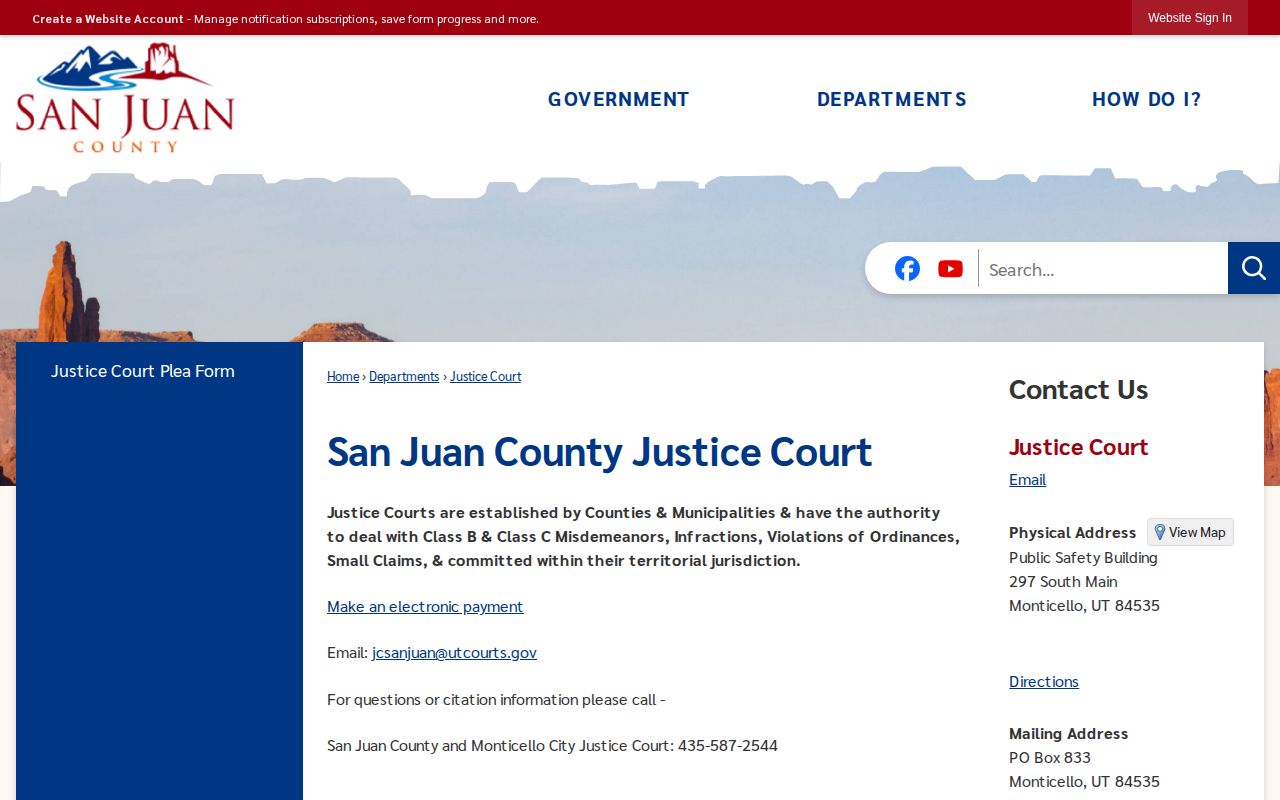
This court source can corroborate a county disposition, but it cannot certify a tribal or federal release.
A court order proves legal authority, not always the moment of physical departure. Processing and unrelated holds can continue. Pair the order with the jail or detention transaction. If the court shows dismissal but the custodian shows transfer on another matter, both records may be accurate.
Navajo Federal Release Routing
When the case is federal, the U.S. Attorney's Office for the District of Utah and the federal docket can help identify the proceeding. For a pretrial person under USMS, there is no public historical marshal locator. Read the detention, bond, dismissal, acquittal, judgment, or commitment order. A transport out of a local bed normally means custody continued.
After a federal sentence and BOP designation, use the BOP locator. A past date with Released or Not in BOP Custody proves only that BOP custody ended. Another sovereign or federal supervised release may remain. If ICE later receives the person, use ODLS and the ICE detention information line for that separate event.
The federal contract-custody page gives the pretrial transfer path. It should be used only when the record identifies federal custody. Tribal geography does not automatically create a federal BOP or marshal record.
Where Navajo Releases Lead
A person leaving a tribal or BIA justice system may enter the community, another detention system, or a court-directed form of supervision, depending on the specific order and custodian. The research does not support a single destination, release lobby, timetable, transport plan, or named tribal facility for all San Juan County cases. Ask the actual operator for case-specific instructions.
Do not apply Utah state parole rules to a tribal or federal release. UDC Adult Probation and Parole verifies state supervision only. Federal supervision comes from the federal judgment. A tribal court or agency controls its own orders and records. If another authority receives custody, the release record should name that transfer before the next locator is used.
Question: Can a county no-result confirm a Navajo release? No. It shows only that no matching current county record was found. The arresting agency, correct court, and actual detention record must resolve the event.
Document a Navajo Custody Release
Build a small packet that can be checked later. Preserve the arresting-agency record, the controlling court order, the detention release or transfer entry, and the receiving agency's record when custody continued. Add the source, date checked, identifiers, exact wording, and any doubt. A dynamic search result is useful evidence but should not be the only proof.
When sources conflict, ask what each one actually proves. A county record can show transfer while a federal docket shows remand. A BOP result can show release while ICE shows detention. A court can authorize release while jail processing or another hold continues. Put the events in order and name the sovereign each time.
- Sovereign
- A government with its own legal authority and records.
- Transfer
- Movement to another custodian, not community release.
- Remand
- A court order that continues custody.
- Discharge
- Completion or termination of the controlling custody or supervision term.
The San Juan County released-inmate search begins with this same last-custodian rule. It prevents the county, Utah, federal, immigration, and tribal systems from being blurred together.